
The Auburn University Marching Band has performed since 1897, when it was formed in part to fulfill the university’s military training requirements, a heritage still visible in the band’s uniforms today, from the shako hats to the ceremonial mace. Unlike Auburn’s athletic programs, AUMB uniforms aren’t replaced every season. Each design typically serves for around a decade before being replaced. This archive documents the band’s unique looks throughout its history, from historic designs through today’s current uniform.
Band Founded
Oldest Documented Design
Current Uniform Debuted
2018 – Present
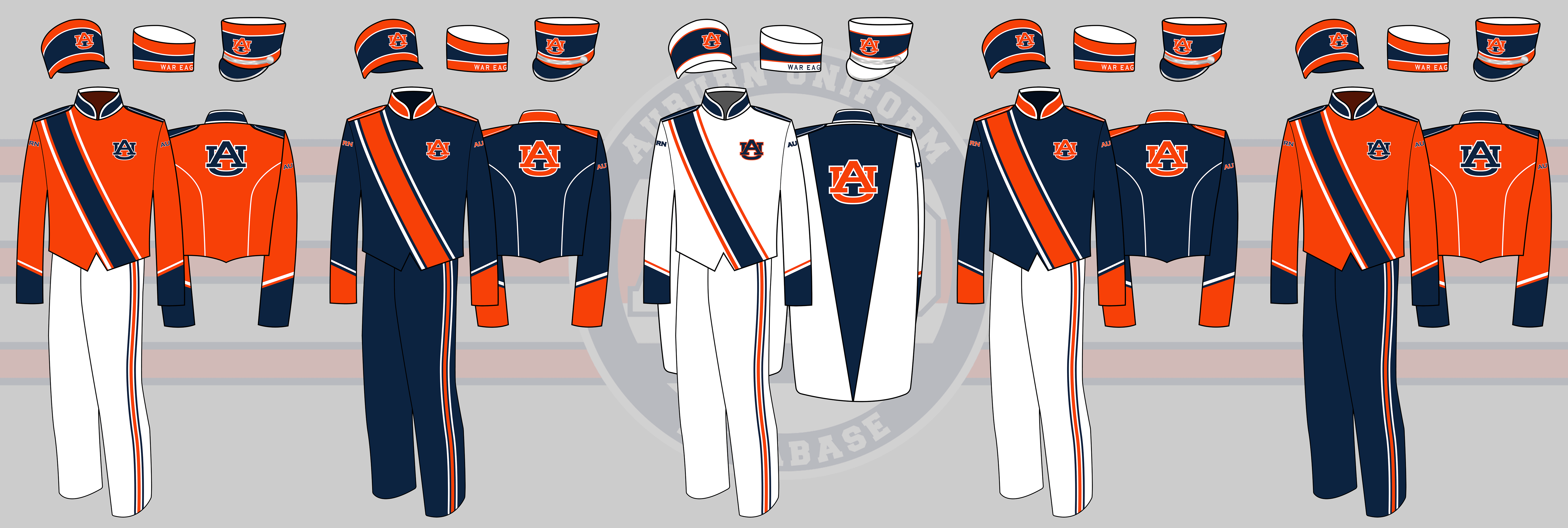
2008 – 2017
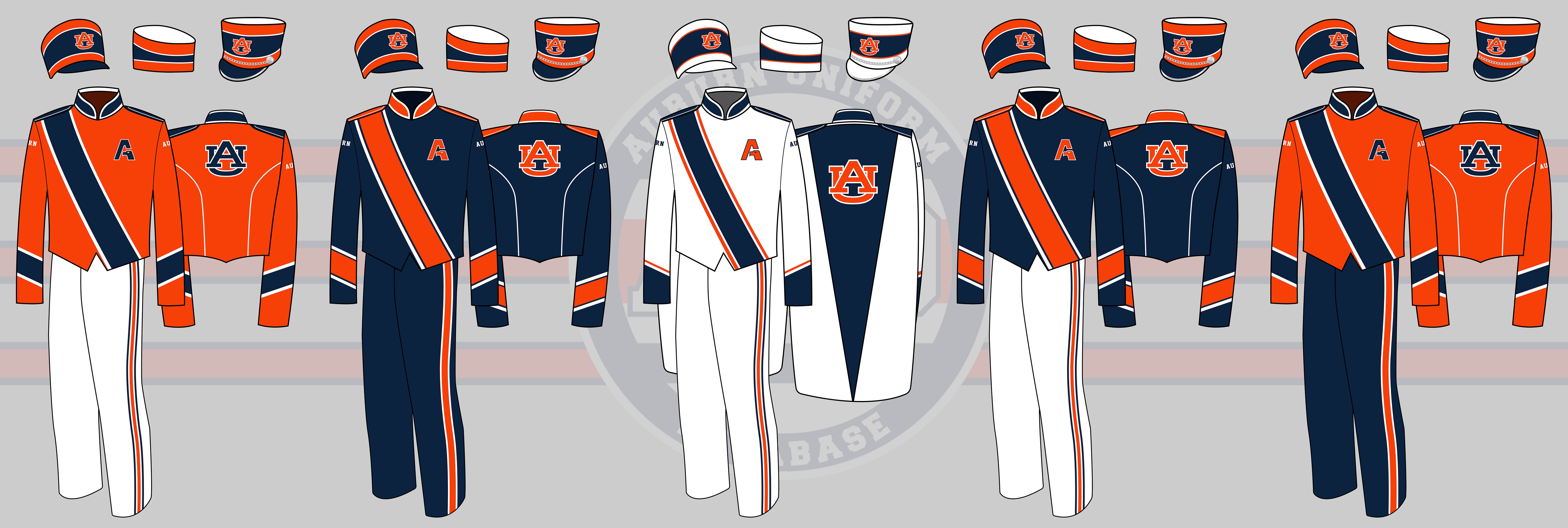
2007
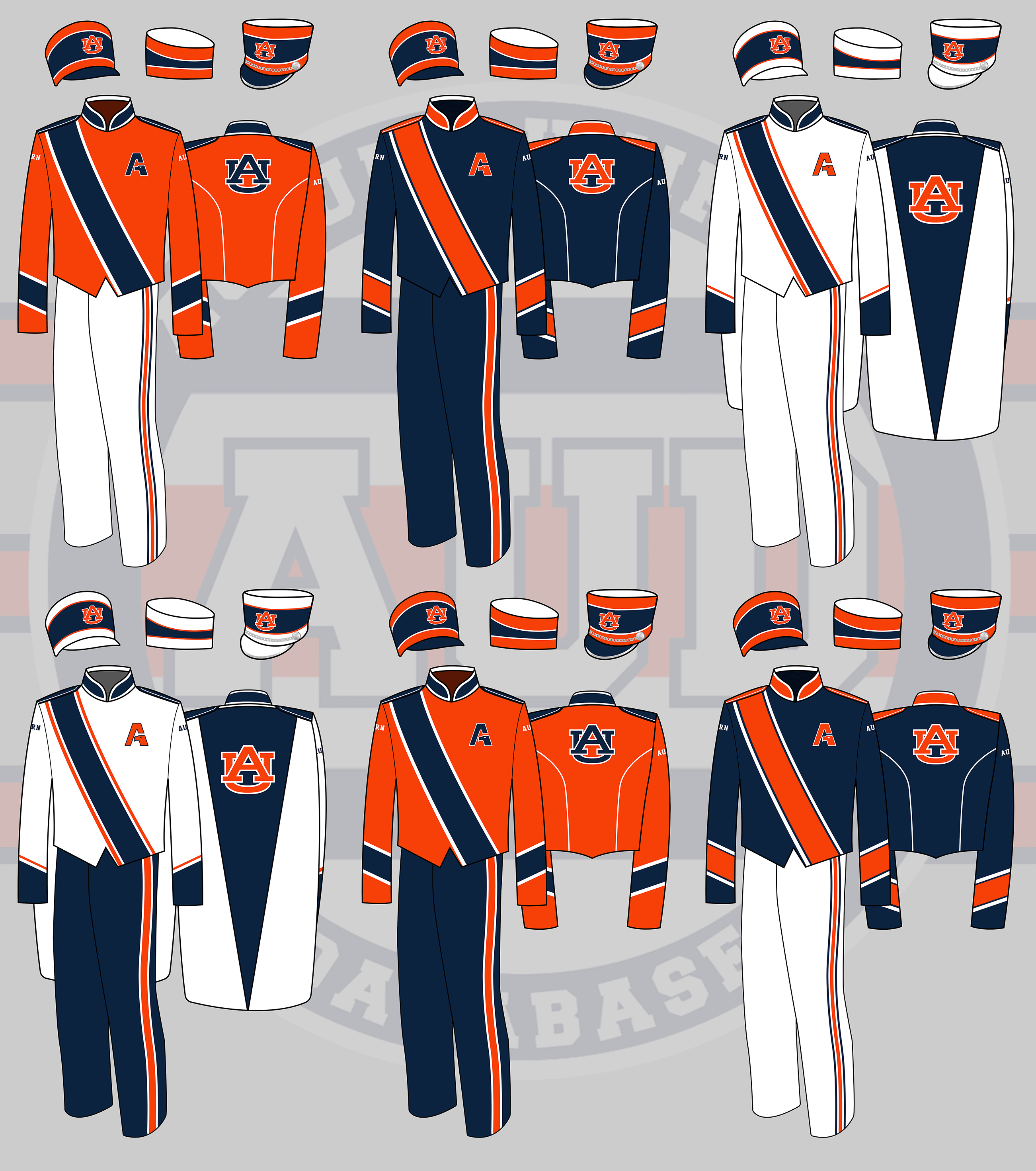
1995 – 2006
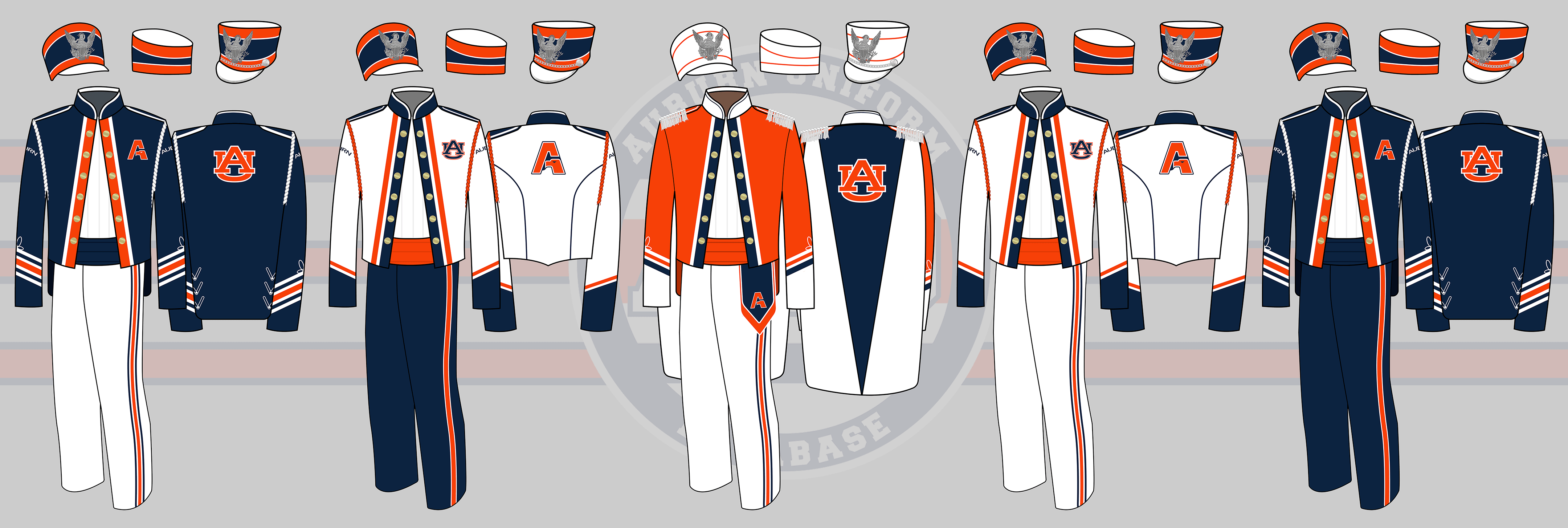
1985 – 1994
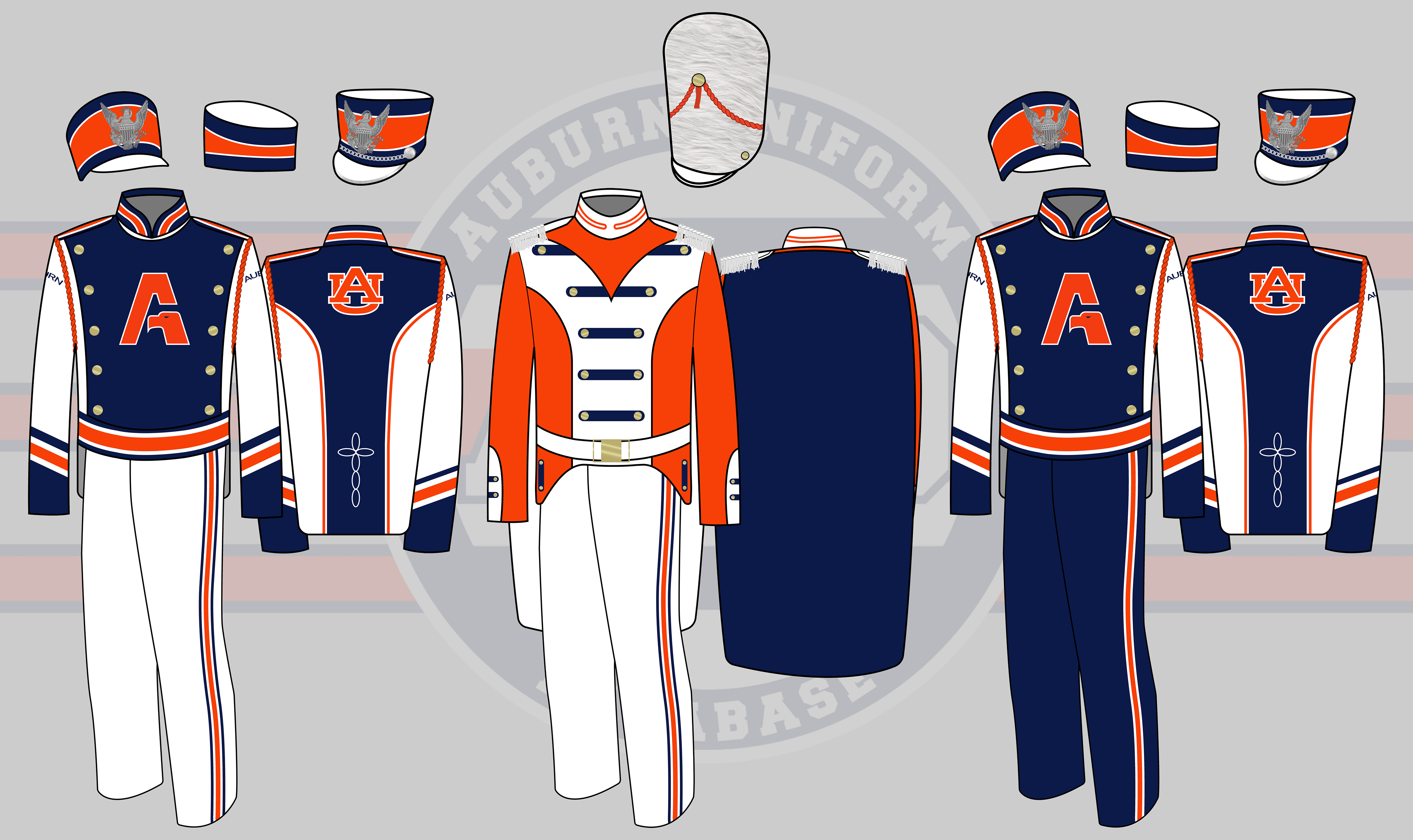
1975 – 1984
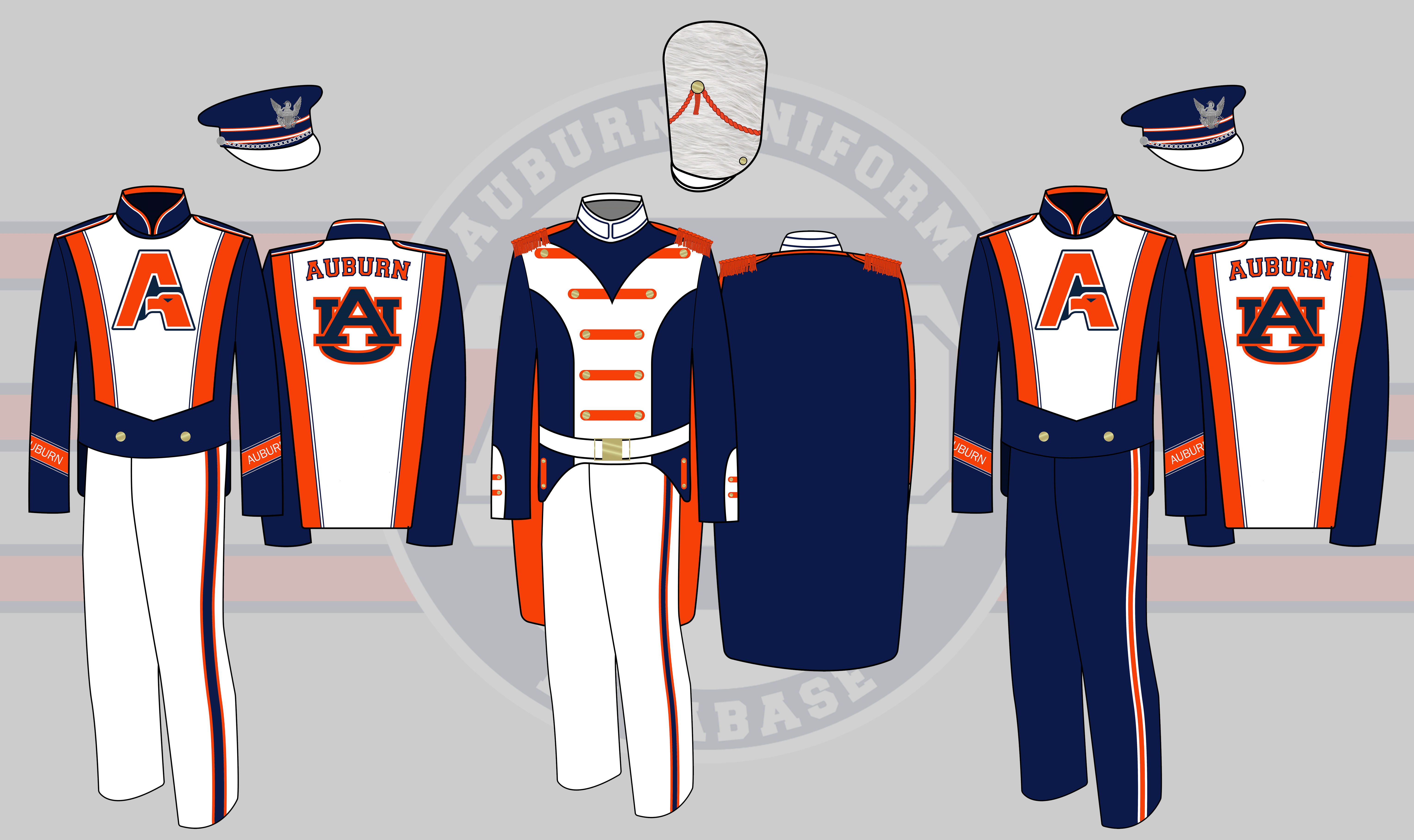
1965 – 1974
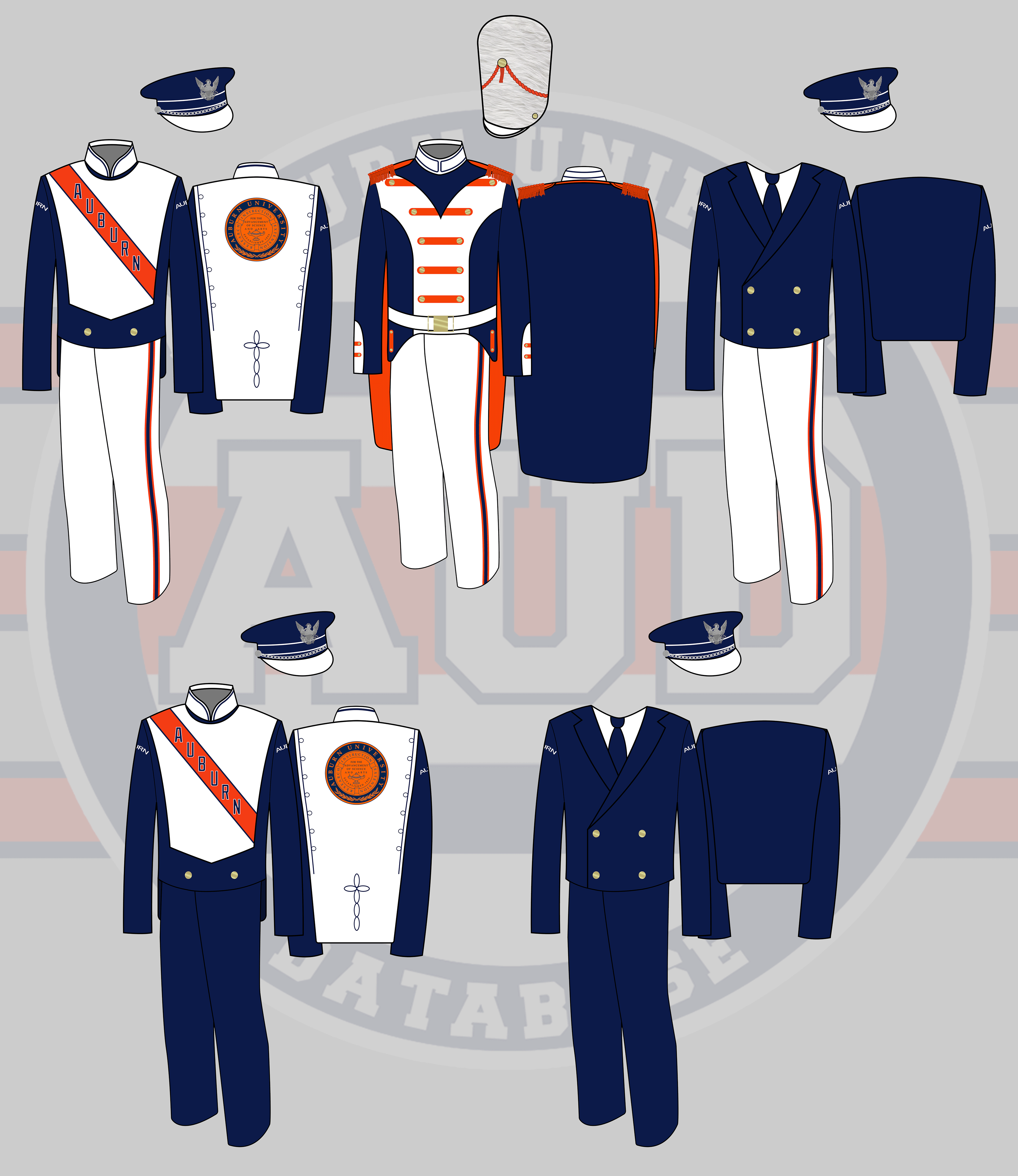
Auburn’s marching band carries deep military roots, both in its uniforms and its traditions. The AUMB was formed in 1897 under director M. Thomas Fullan, born partly out of a requirement to teach military tactics on a campus that accepted state funding. That heritage still shows up today: the shako hats and their feathered plumes both trace back to 19th-century war uniforms, when soldier dress leaned more toward ceremony than practicality. Even the drum majors’ mace, used in the pregame salute, is a tradition inherited from military band leadership.
The band purchased new uniforms in 1985, described at the time as “West Point uniforms,” continuing that military-inspired design history. The current uniform design debuted in 2007, replacing a design that had featured orange-clad drum majors and an optional white uniform for the band. In 2018, Auburn introduced the current set, keeping the overall design relatively untouched. There was one significant change, however: the “band A” logo, a design blending an eagle head into the shape of the letter A, worn since at least the 1970s and cherished by generations of band members and alumni, was replaced by the standard AU logo used across the rest of the university’s branding. The shift proved unpopular among current and former band members, even as it aligned the band visually with the rest of Auburn Athletics and Auburn University.
Beyond the band itself, the Tiger Eyes, the AUMB’s visual ensemble, bring their own uniform history. The majorette line traces its roots to the 1940s, the flag line joined in 1985, and the dance line was added in 2005, the same year the “Tiger Eyes” name was given to the combined group. Each line wears its own handmade, fully sequined uniform, with a new design crafted every season — a level of yearly turnover that stands in contrast to how long the band’s own uniforms typically last.
One more piece of trivia ties the band directly into Auburn’s broader athletic identity: the interlocking AU logo used across the university today originated with Fritz Siler, an AUMB drummer who sketched the design onto the side of his drum in 1965. It debuted at the 1966 A-Day game months before the football team ever wore it on a helmet. However, Siler has never been officially credited as its creator.
Uniforms documented and presented here are confirmed through archived photos, video, and program history to represent Auburn University Marching Band’s distinct uniform designs over time. Since AUMB uniforms are typically worn for roughly a decade before being redesigned, new looks are added to this archive as they’re documented and confirmed. Older uniforms require immense photo references to get the details accurate, as band uniforms don’t stick to a standard template, unlike sports uniforms.
 https://auburnuniforms.com/wp-content/uploads/2024/11/gym.png
700
700
Clint Richardson
https://auburnuniforms.com/wp-content/uploads/2024/11/Auburn-Uniform-Database-Logo-site.png
Clint Richardson2023-01-01 22:14:112026-07-18 20:23:37Gymnastics
https://auburnuniforms.com/wp-content/uploads/2024/11/gym.png
700
700
Clint Richardson
https://auburnuniforms.com/wp-content/uploads/2024/11/Auburn-Uniform-Database-Logo-site.png
Clint Richardson2023-01-01 22:14:112026-07-18 20:23:37Gymnastics https://auburnuniforms.com/wp-content/uploads/2024/11/Auburn-Volleyball.png
700
700
Clint Richardson
https://auburnuniforms.com/wp-content/uploads/2024/11/Auburn-Uniform-Database-Logo-site.png
Clint Richardson2018-11-24 19:19:062026-07-21 21:46:19Volleyball
https://auburnuniforms.com/wp-content/uploads/2024/11/Auburn-Volleyball.png
700
700
Clint Richardson
https://auburnuniforms.com/wp-content/uploads/2024/11/Auburn-Uniform-Database-Logo-site.png
Clint Richardson2018-11-24 19:19:062026-07-21 21:46:19Volleyball https://auburnuniforms.com/wp-content/uploads/2024/11/Auburn-Soccer.png
700
700
Clint Richardson
https://auburnuniforms.com/wp-content/uploads/2024/11/Auburn-Uniform-Database-Logo-site.png
Clint Richardson2018-06-28 01:23:512026-07-21 21:46:16Soccer
https://auburnuniforms.com/wp-content/uploads/2024/11/Auburn-Soccer.png
700
700
Clint Richardson
https://auburnuniforms.com/wp-content/uploads/2024/11/Auburn-Uniform-Database-Logo-site.png
Clint Richardson2018-06-28 01:23:512026-07-21 21:46:16Soccer https://auburnuniforms.com/wp-content/uploads/2024/11/Auburn-Softball.png
700
700
Clint Richardson
https://auburnuniforms.com/wp-content/uploads/2024/11/Auburn-Uniform-Database-Logo-site.png
Clint Richardson2018-06-28 01:19:332026-07-21 21:46:17Softball
https://auburnuniforms.com/wp-content/uploads/2024/11/Auburn-Softball.png
700
700
Clint Richardson
https://auburnuniforms.com/wp-content/uploads/2024/11/Auburn-Uniform-Database-Logo-site.png
Clint Richardson2018-06-28 01:19:332026-07-21 21:46:17Softball https://auburnuniforms.com/wp-content/uploads/2021/04/Auburn-Football.png
700
700
Clint Richardson
https://auburnuniforms.com/wp-content/uploads/2024/11/Auburn-Uniform-Database-Logo-site.png
Clint Richardson2018-06-28 01:18:062026-07-21 21:46:14Football
https://auburnuniforms.com/wp-content/uploads/2021/04/Auburn-Football.png
700
700
Clint Richardson
https://auburnuniforms.com/wp-content/uploads/2024/11/Auburn-Uniform-Database-Logo-site.png
Clint Richardson2018-06-28 01:18:062026-07-21 21:46:14Football https://auburnuniforms.com/wp-content/uploads/2024/11/Auburn-Womens-Basketball.png
700
700
Clint Richardson
https://auburnuniforms.com/wp-content/uploads/2024/11/Auburn-Uniform-Database-Logo-site.png
Clint Richardson2018-06-28 01:15:452026-07-21 21:46:13Basketball (Women’s)
https://auburnuniforms.com/wp-content/uploads/2024/11/Auburn-Womens-Basketball.png
700
700
Clint Richardson
https://auburnuniforms.com/wp-content/uploads/2024/11/Auburn-Uniform-Database-Logo-site.png
Clint Richardson2018-06-28 01:15:452026-07-21 21:46:13Basketball (Women’s) https://auburnuniforms.com/wp-content/uploads/2024/11/Auburn-Mens-Basketball.png
700
700
Clint Richardson
https://auburnuniforms.com/wp-content/uploads/2024/11/Auburn-Uniform-Database-Logo-site.png
Clint Richardson2018-06-28 01:13:412026-07-20 20:33:04Basketball (Men’s)
https://auburnuniforms.com/wp-content/uploads/2024/11/Auburn-Mens-Basketball.png
700
700
Clint Richardson
https://auburnuniforms.com/wp-content/uploads/2024/11/Auburn-Uniform-Database-Logo-site.png
Clint Richardson2018-06-28 01:13:412026-07-20 20:33:04Basketball (Men’s) https://auburnuniforms.com/wp-content/uploads/2024/11/Auburn-Baseball.png
700
700
Clint Richardson
https://auburnuniforms.com/wp-content/uploads/2024/11/Auburn-Uniform-Database-Logo-site.png
Clint Richardson2018-06-28 01:09:112026-07-20 20:28:44Baseball
https://auburnuniforms.com/wp-content/uploads/2024/11/Auburn-Baseball.png
700
700
Clint Richardson
https://auburnuniforms.com/wp-content/uploads/2024/11/Auburn-Uniform-Database-Logo-site.png
Clint Richardson2018-06-28 01:09:112026-07-20 20:28:44Baseball